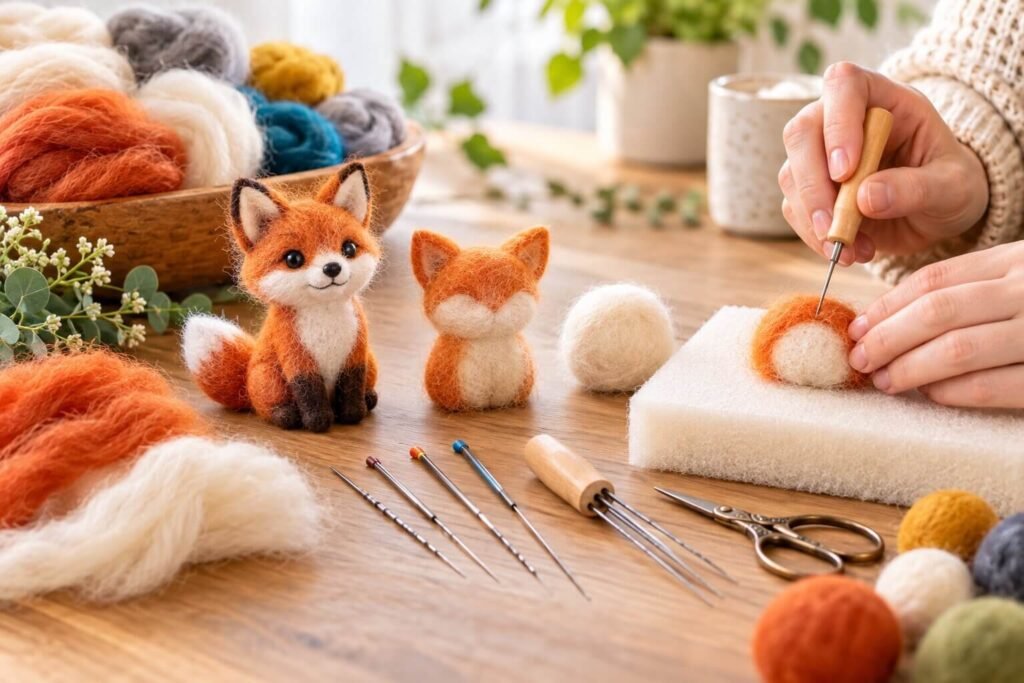
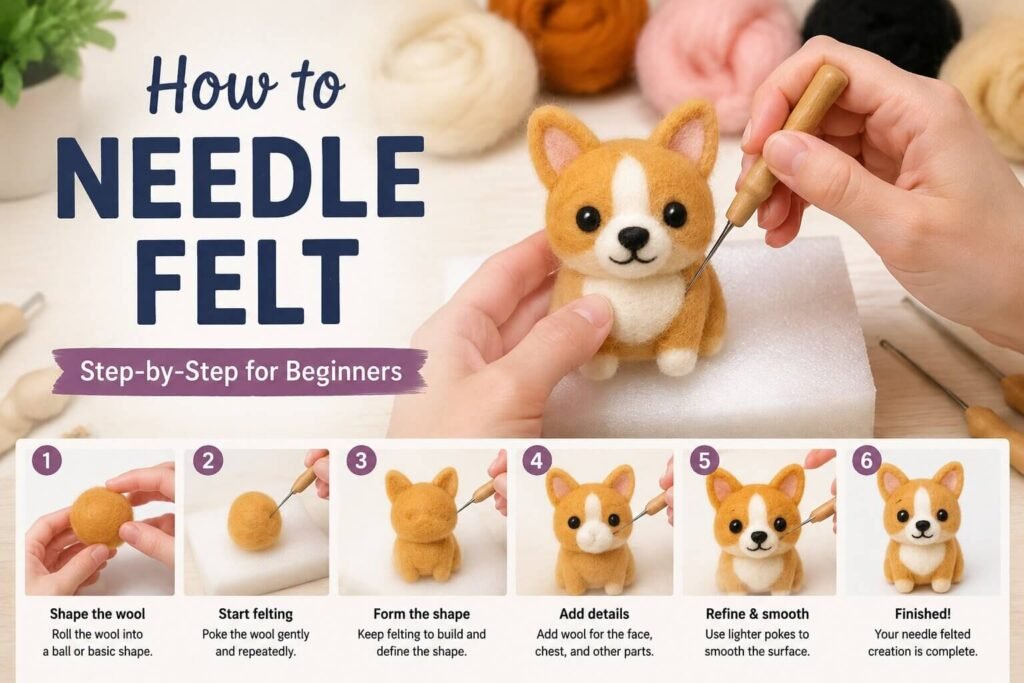
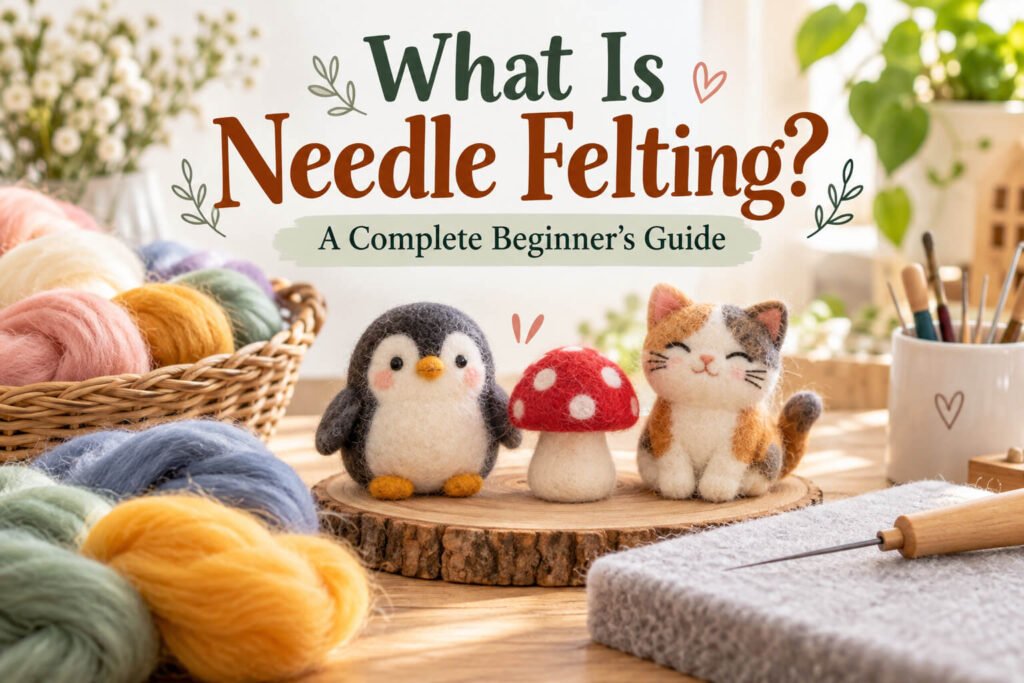
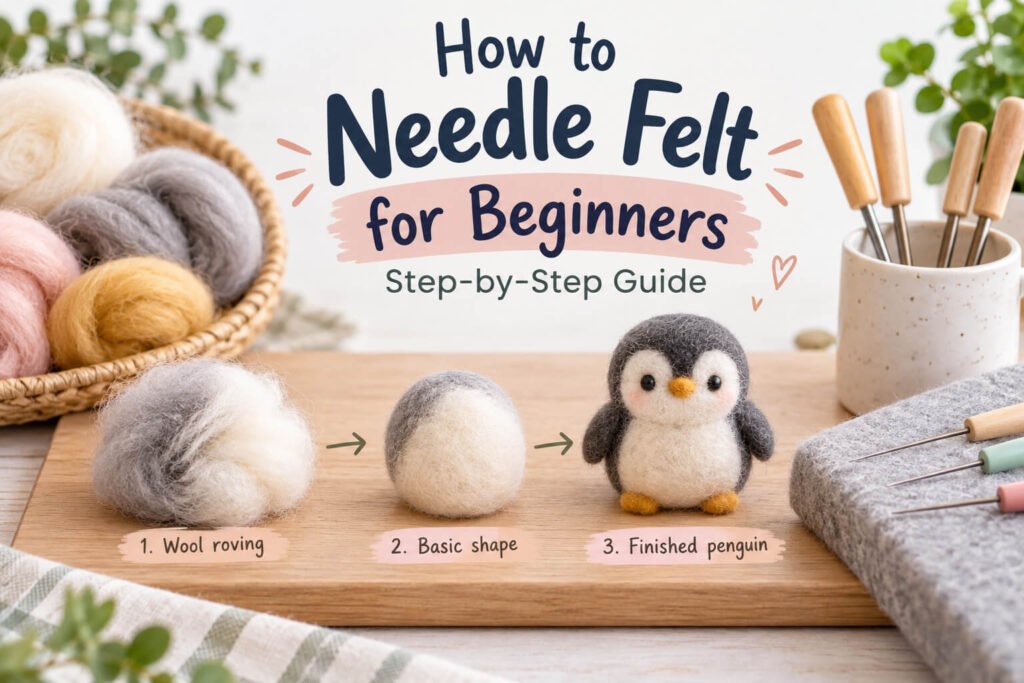
Needle felting can seem unusual when you first watch someone do it.
There is no glue.
There are no stitches.
Yet loose wool gradually becomes firm enough to hold the shape of an animal, ornament, or sculpture.
If you are completely new to the craft, you may want to begin with
what is needle felting?
The Basic Principle of Needle Felting
Needle felting uses a specially designed barbed needle.
As the needle passes into the wool, the barbs catch fibers and move them through the surrounding fiber.
Repeated motion causes the wool to become increasingly tangled and compact.
Eventually, it begins to hold a firm shape.
Why Doesn’t a Normal Sewing Needle Work?
A sewing needle is designed to pass through fabric smoothly.
A felting needle contains barbs.
Those barbs are a major part of what makes the felting process work.
Repeatedly poking wool with a smooth ordinary needle does not create the same result efficiently.
Why Is Wool Good for Felting?
Wool fibers have physical characteristics that allow them to interact and lock together.
Different types of wool behave differently.
Some are quick to compact.
Others may be finer or more suitable for delicate surface work.
What Happens When You First Begin Felting?
Loose wool contains a large amount of air.
At the beginning, your needle work starts reducing that airy structure.
The fibers become more connected.
The piece becomes smaller and firmer.
Why Does Needle Felted Wool Shrink?
The wool itself is being compressed.
You are removing space between fibers and creating a denser form.
This is why beginners should expect a loose starting bundle to become smaller.
How Do You Create Different Shapes?
Needle felting is controlled compression.
If you work one area more heavily, that section becomes denser and smaller.
This allows you to sculpt.
You can flatten a surface, narrow a neck, create an indentation, shape a muzzle, or define a paw.
How Do You Add More Volume?
Place loose wool over the area that needs more material.
Felt the new fiber into the existing surface.
This allows you to build cheeks, shoulders, muscles, eyebrows, muzzles, and other features.
Needle felting is forgiving because you can repeatedly add material.
How Are Separate Pieces Joined?
When making a separate ear or limb, leave some fibers loose where the piece will attach.
Place those loose fibers against the main body.
Felt them into the sculpture.
Additional surface wool can be used to strengthen or smooth the joint.
How Is Color Added?
A sculpture can be built with neutral core wool and covered with a thinner surface layer.
This allows you to save decorative colors.
You can also build markings by felting small amounts of different colors onto the surface.
How Do Artists Create a Smooth Finish?
A smooth surface begins with an even core.
Thin outer layers help.
Controlled shallow needle work and a finer needle can refine the appearance.
Surface finishing should happen after the overall shape is correct.
How Is Realistic Fur Made?
Some realistic fur is created by attaching only part of a longer fiber bundle.
The rest remains loose.
Artists then layer the fibers in the direction the real animal’s fur would grow.
Different methods can create short, fluffy, or long-haired effects.
What Is a Reverse Felting Needle?
A reverse needle can pull fibers from inside the sculpture outward.
This can create a fuzzier surface.
It is useful for certain animal textures.
Why Is Needle Angle Important?
Felting needles are thin.
If you push one direction and then bend sideways while the needle is buried in the wool, it can break.
Insert and withdraw in a controlled path.
Why Do You Need a Felting Mat?
The needle may pass all the way through the project.
A proper mat protects your table and provides a safer surface.
It also reduces the chance that you will accidentally work directly toward your hand.
Try Needle Felting Yourself
Once you understand the basic principle, the best way to learn is through practice.
Our
step-by-step needle felting guide for beginners walks you through creating and shaping your first project.
How Much Wool Does Felting Use?
The amount depends on the project size and density.
Our guide to
how much wool you need for needle felting explains the major factors.
Is Needle Felting Permanent?
Properly felted wool holds together because the fibers are physically entangled.
However, a handmade sculpture can still be damaged through rough handling, pulling, abrasion, or unsuitable cleaning.
Treat finished pieces as handcrafted art.
How Is Needle Felting Different From Wet Felting?
Needle felting primarily uses a barbed needle and dry fibers.
Wet felting uses moisture, soap, pressure, and agitation.
For a complete comparison, read
needle felting vs. wet felting.
Why Is Needle Felting So Good for Sculpture?
You can add material, reduce areas, change proportions, attach pieces, and create detailed surfaces.
That flexibility is ideal for animals and pet portraits.
Explore wool, needles, mats, kits, and animal-project supplies from
FeltMyPet and experience how loose fiber becomes three-dimensional art.