Needle felting looks simple when you watch an experienced artist work.
The basic movement is simple, but there are many small lessons that can make your first projects much easier.
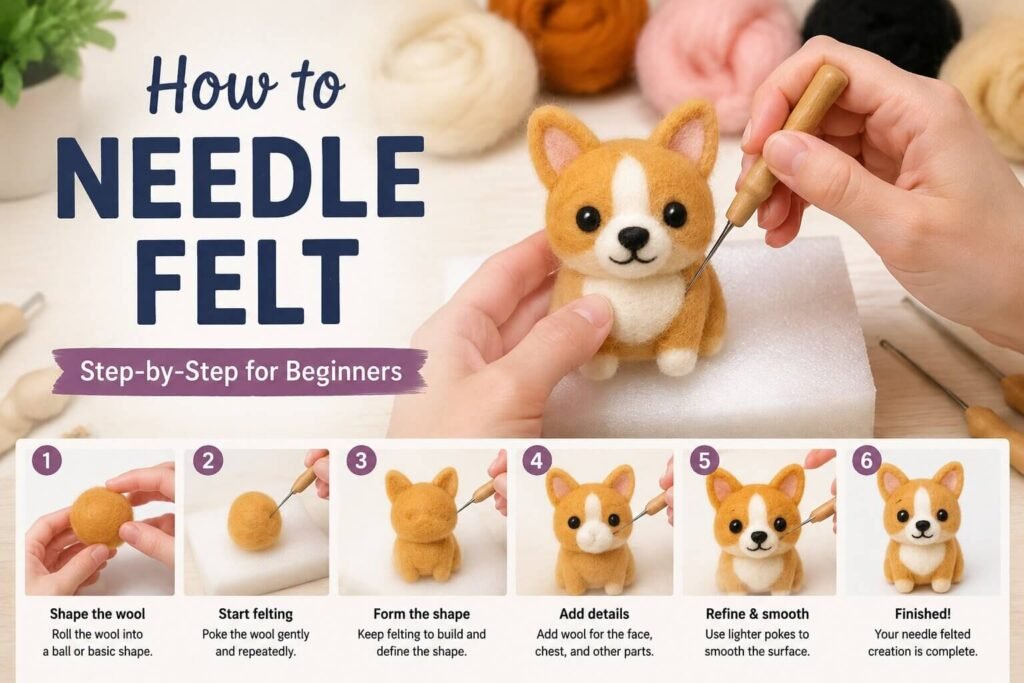
If you would rather see the process from beginning to end first, follow our
step-by-step needle felting guide for beginners.
1. Felting Needles Are Extremely Sharp
Always keep track of where the needle is going.
Work on a proper mat.
Keep your supporting fingers away from the needle path.
2. Felting Needles Can Break
A felting needle is thin.
Push it into the wool and pull it back out along the same general direction.
Avoid twisting it sideways while it is embedded.
3. Wool Shrinks During Felting
Loose wool contains air.
As the fiber becomes compact, your project gets smaller.
Do not expect the starting volume to match the final size.
4. Start With Less Wool
It is easier to add fiber than to remove a dense section.
Build gradually.
This is especially important around the face.
5. Different Needles Have Different Jobs
A needle useful for fast core shaping may not be the best choice for fine finishing.
You do not need every type at first, but understanding the basic differences makes work easier.
6. Build a Firm Core
Do not rely on surface color to hold a sculpture together.
The internal structure should be stable before you focus on details.
7. Rotate the Project Constantly
If you work from only one angle, you may accidentally create a flat or distorted form.
Turn the project frequently.
8. Learn Basic Shapes
Practice making balls, ovals, cylinders, cones, and flat shapes.
These are the building blocks of animals.
9. Make Paired Parts Together
If you need two ears, alternate between them.
This improves symmetry.
Use the same method for legs, wings, or paws.
10. Leave Loose Fibers for Joining
Do not completely felt every attachment point.
Loose fibers make it easier to connect one part to another.
11. Tiny Features Need Tiny Amounts of Wool
A little wool goes a long way on a small face.
Beginners often make noses, brows, and cheeks too large.
12. Reference Photos Are Important
Even if you are creating a stylized animal, study real examples.
Look at ear position, eye spacing, leg length, body shape, and markings.
13. A Fuzzy Surface Is Normal
Beginners sometimes think a fuzzy project means failure.
It does not.
Surface refinement is a separate skill.
14. Your First Project Will Not Look Like an Expert’s
Experienced artists have practiced many times.
Your first project is supposed to teach you, not prove your ability.
15. Needle Felting Should Be Fun
Experiment.
Use unexpected colors.
Make funny expressions.
You are allowed to create something that is not perfectly realistic.
Do Not Buy Too Many Supplies at First
New crafters sometimes buy huge collections before discovering what they actually enjoy.
Our guide to
essential needle felting supplies can help you keep your starter setup practical.
Work From Large Shapes to Small Details
Finish the overall proportions before adding eyes.
A beautiful eye cannot fix a head that is the wrong size.
This habit will save you a lot of reworking.
Practice in Short Sessions
You do not need to felt for hours every day.
You can practice one technique at a time.
Spend one session making balls.
Another can focus on ears.
Another can practice attachments.
Short practice is still useful.
Learn When to Stop Felting
More needle work is not automatically better.
Once the shape has the firmness and form you want, move on.
Overworking one area can make it unnecessarily hard.
Keep Your Workspace Organized
Do not leave sharp needles hidden inside wool.
Use containers for needles, wool scraps, eyes, wire, and small accessories.
A clean workspace is safer.
Use Good Lighting
Bright lighting helps with both safety and detail work.
This is particularly important when you are working with dark wool.
Take Breaks
Repeated hand movements can become tiring.
Relax your shoulders and hands periodically.
A short break also lets you return to your sculpture with fresh eyes.
Study the Sculpture From Every Angle
When you think it looks right, rotate it slowly.
Check the head, back, legs, ears, and tail.
Three-dimensional art needs to work from more than one viewing angle.
Mistakes Are Part of Learning
Understanding common problems helps you improve faster.
Read our guide to
beginner needle felting mistakes for troubleshooting advice.
Create a Practice Routine
If you want to build your skills systematically, follow our guide on
how to learn needle felting at home.
Build Confidence One Project at a Time
Needle felting basics become much easier once your hands understand the wool.
Reading helps, but practice is what develops control.
Explore wool, kits, needles, mats, and beginner project supplies at
FeltMyPet and build your skills through projects you enjoy.